
Champaign County Court Records After Arrest
Champaign County court records after a jail arrest run through three local offices with different jobs. The Champaign County Sheriff's Office books the person into the Champaign County Jail and creates jail records about arresting agency, intake charges, custody status, bond or release notes, and movement. The Champaign County State's Attorney, led by State's Attorney Julia Rietz, decides which criminal or traffic charges are prosecuted in Circuit Court. The Champaign County Circuit Clerk then maintains the public case record and court file for the filed case.
The local path is arrest, booking, first appearance or detention hearing, prosecutorial filing, and Circuit Clerk case record. The Sheriff's daily booking report and Tyler jail portal can be useful starting points because they may list the name, SO number, booking number, arrest date, arresting agency, case references, and preliminary charges. Those records do not replace the court file. Custody and booking details belong with Champaign County jail inmate records, while booking-photo questions belong with Champaign County jail mugshots. Filed charges, court dates, dispositions, copies, and certifications belong with the Circuit Clerk.
Search Court Records After Jail Arrest
The starting court source is the Champaign County Circuit Clerk. The Circuit Clerk links to the Public Court Case Record Search, also identified in the research as the Clericus Magnus portal. The portal is the official public case-search target for filed cases. If a browser search does not show enough detail, the fallback is the Circuit Clerk's public file inspection and copy process, not Sheriff's FOIA.
The Circuit Clerk court-file page says public criminal files can include a docket sheet, charging documents, and the record of proceedings on arraignment. It also states that police reports, transcripts, evidence, and exhibits are not in the court file. That boundary matters after an arrest because a reader may need both channels: the court record for filed charges and case status, and the police department or Sheriff's Office for law-enforcement reports.
- Start with the jail booking report or Tyler portal if the arrest is recent. Capture the full name, booking date, arresting agency, SO number, booking number, and any case number.
- Check the Sheriff's In-Custody Arraignment Report when the person is still held. It may list hearing date, hearing type, courtroom, cell, SO number, booking number, and case references.
- Search the Circuit Clerk public case system by defendant name or case number. Case styles observed in local reports include CF, CM, DT, and TR formats.
- If the online case is incomplete, contact or visit the Circuit Clerk at 101 East Main Street, Urbana, IL 61801, phone 217-384-3725.
- Request copies or certifications from the Circuit Clerk when an official court document is needed.
| Search Source | Use It For | Limits |
|---|---|---|
| Public Court Case Record Search | Filed cases, charge lists, case events, and court status. | Browser access may be needed, and not every document is shown online. |
| Defendant name | Finding a case when the case number is unknown. | Spelling, aliases, and middle names can affect results. |
| Case number | Direct lookup when a jail report or arraignment report lists a case reference. | Booking numbers and court case numbers are not the same. |
| Circuit Clerk file viewing | Older files, copies, certification, and records not fully visible online. | Restricted files and documents are not public. |
Champaign Court Charging Documents
After a Champaign County jail arrest, the charging document is the bridge between custody and the court record. A booking entry may show an alleged offense at intake, but the filed court charge is the one the State's Attorney commences or prosecutes in Circuit Court. The State's Attorney website says the office prosecutes criminal and traffic cases in the Circuit Court and also initiates juvenile petitions and proceedings. The court file, when public, is where the filed document and docket history are tracked.
The exact document depends on the case type and procedure. The local research does not say that every case uses each form, so the table below uses the standard criminal-court distinctions while keeping the Champaign County routing clear. The Circuit Clerk is the record custodian for filed court documents. The Sheriff's Office is the records route for booking records and police reports controlled by the Sheriff's Office.
| Complaint | Information | Indictment | |
|---|---|---|---|
| Filed By | Often initiated by law enforcement or prosecutor action. | Filed by the prosecutor. | Returned by a grand jury and filed in court. |
| Common Use | Initial criminal or traffic charging path. | Many prosecuted criminal cases. | Serious felony path when grand-jury action is used. |
| Record Value | Shows the accusation that starts or supports the case. | Shows the prosecutor's filed charge. | Shows a grand-jury charge. |
| Where to Request | Circuit Clerk public file or copy request. | Circuit Clerk public file or copy request. | Circuit Clerk public file or copy request, unless restricted. |
Champaign Arrest Charge Status
Champaign County court records after arrest can show several different charge states. A jail record may list a booking charge, a court case number, a disposition such as Not Charged, or a release status such as Released on Pre-Trial Release. A court record is better for the formal charge status because the prosecutor may file, amend, reduce, dismiss, or decline a count after booking. A booking charge is an allegation at the custody stage. It is not a conviction.
Misdemeanor process details from the State's Attorney add local timing context. The office describes arraignment as the defendant's first court appearance. A pre-trial hearing is a scheduling hearing where a trial date, guilty plea date, or continuance may be requested. The same local page says it can take several months from initial filing of criminal charges to final disposition in a misdemeanor case. Victims or witnesses may contact Victim Services at 217-384-3733 or check case status online through the Circuit Clerk.
| Status | What It Means in the Court Record |
|---|---|
| Pending | A charge has been filed and no final disposition has been entered on that count. |
| Amended | The filed charge was changed after the original filing. |
| Reduced | The charge was lowered to a lesser offense or class. |
| Dismissed | The count ended without a conviction on that charge. |
| Nolle Prosequi | The prosecutor declined to proceed on the charge. |
| Court Supervision | An Illinois disposition that may avoid conviction if completed, depending on the offense and law. |
| Conviction | A formal finding or judgment of guilt. It is different from arrest, booking, or filing. |
Champaign Court File Access
The Circuit Clerk's court-file page is a useful source because it lists both what the file may contain and what it will not contain. Before relying on an online case summary, check the View a Court File page for the public-file boundaries and copy fees. The page says the majority of case files are available to the public, but it lists exceptions for adoption, juvenile abuse and neglect, juvenile delinquency, expunged or sealed cases, cases with juvenile victims, sexual assault cases by administrative order, eavesdropping, and cases impounded by judicial order.
The Circuit Clerk page also lists restricted documents within otherwise public files, including financial statements, medical records, mental health records, Social Security numbers, and other personal identity information. Copy fees are local and concrete: $2.00 for the first page, $0.50 for each subsequent page up to 20 pages, $0.25 for each page after that, and an additional $5.00 per certification. The accepted payment types listed are cash, checks, money orders, and cashier's checks.
The Circuit Clerk court-file page is the best matched screenshot for court-record access in the image manifest.
The Circuit Clerk file-access page shows the public-file categories, unavailable materials, and copy fees used for court records after a Champaign County arrest.
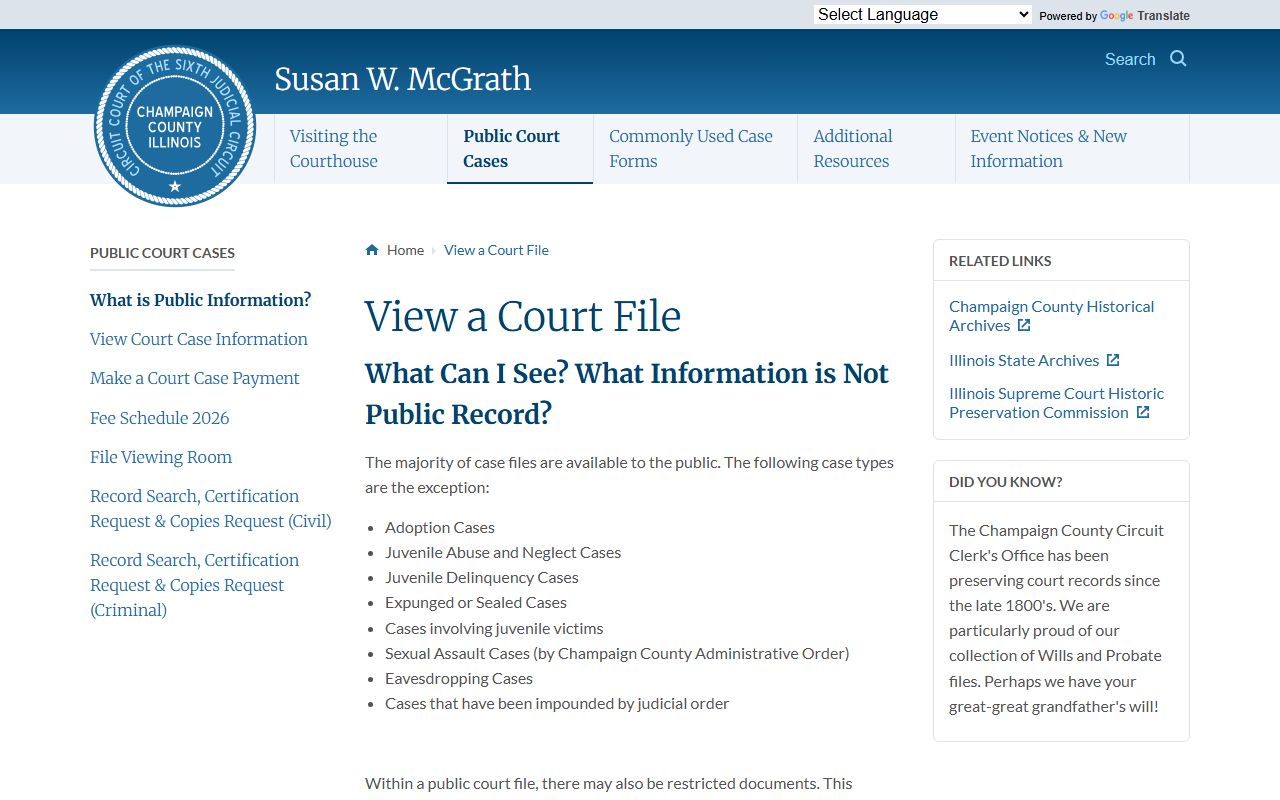
Use that court-file route when the online case summary is not enough or when certified copies are needed for a filed criminal or traffic case.
Bond, Warrants, and Arrest
Illinois no longer uses money bond as the routine release path in the same way many states do. The Sheriff's 2025 annual report explains that, with few exceptions, there is no longer money bond in Illinois. If the State's Attorney is not seeking detention, the arrestee is released with pretrial conditions. If detention is sought, a judge holds a detention hearing. This is why Champaign County court records after a jail arrest may show pretrial release, detention, conditions, or later court status instead of a simple bail-bond path.
Local bond-payment instructions still matter when a bond or payment applies. The Sheriff's inmate resources page says cash or credit-card bonds may be paid at the Champaign County Jail, and it encourages callers to confirm the needed amount at 217-384-1243 or 217-384-1240 before paying. Cashier's checks are made out to the Champaign County Circuit Clerk. Holds can also change the result. A transfer to another state or county authority, a fugitive hold, a detainer, an IDOC sentence, or a federal issue may keep a person from being released even when a local payment question appears resolved.
No standalone official active-warrant search was located in the research. For warrant context, use the jail booking reports, Circuit Clerk case search, Sheriff's Criminal Records contacts, and written FOIA fallback depending on whether the record is court-based or law-enforcement-based.
Routing rule: Court dates and filed charges go to the Circuit Clerk; custody, booking reports, and Sheriff's records go to the Sheriff's Office.
Champaign Charges vs Convictions
Champaign County court records after arrest should be read with a clear charge-versus-conviction split. An arrest means a person was taken into custody. A booking charge means an alleged offense was entered during jail intake or arrest processing. A filed charge means the State's Attorney has put a charge into the Circuit Court case. A conviction means guilt was formally found by plea, verdict, or judgment. These stages can look similar in a public search result, but they carry very different meanings.
| Charge | Conviction | |
|---|---|---|
| Stage | Accusation in a jail, prosecutor, or court record. | Final or formal finding of guilt on a count. |
| Proof Level | May start from probable cause or prosecutor filing. | Requires plea, verdict, or judgment under criminal procedure. |
| Can Change | May be amended, reduced, dismissed, or declined. | May affect sentence, supervision, probation, appeal, or record-clearing options. |
| Best Source | Circuit Clerk case record for filed charges, jail record for booking charges. | Circuit Clerk disposition and official court file. |
Sealed and Expunged Court Records
Sealed and expunged records are not ordinary public court files. The Circuit Clerk lists expunged or sealed cases among public-file exceptions. Illinois sealing and expungement law appears in the research under the Criminal Identification Act, 20 ILCS 2630/5.2. The practical point for Champaign County is that public search access may change after a court order. A dismissal alone does not automatically mean every public trace disappears from every system. The order and the record custodian matter.
| Sealed | Expunged | |
|---|---|---|
| Public View | Hidden from ordinary public access after the court grants sealing. | Removed or treated as cleared under the expungement order and applicable law. |
| Where It Starts | Court process under Illinois law. | Court process under Illinois law. |
| Record Holders | Courts and agencies may have controlled access as law allows. | Agencies update records according to the order and law. |
| Best Local Step | Use the Circuit Clerk for the court file and order status. | Provide the order to the office that controls the record at issue. |
Champaign Court Records Public Access
Illinois FOIA and court-record access are related but not the same. The Champaign County General Information FOIA page says public court records do not require a FOIA request and are available through the Circuit Clerk at the courthouse and on the Circuit Clerk website. For Sheriff's records that are not online, the Sheriff's FOIA form is the written route. The form asks for enough detail to locate the record and gives delivery choices by U.S. mail, email, pickup, or fax. Illinois FOIA generally gives a public body five business days to respond, with a limited extension.
For court records after a jail arrest, use this order: public court case search, Circuit Clerk file viewing or copies, then the originating police or Sheriff's records route for police reports. For statewide criminal-history context, Illinois FOIA section 5 ILCS 140/2.15 covers chronologically maintained arrest information, including photographs when available, but it also allows withholding in some safety, investigation, and correctional-security situations. Court supervision, sealing, expungement, juvenile status, sexual-assault administrative orders, and impoundment can all affect public access.
Important: Champaign County Inmate Population is not a consumer reporting agency, and these records are not for employment, credit, tenant, insurance, or other FCRA-covered decisions.